
I don't want my kids to be "successful"
Growing up, being successful meant following rules, behaving, and adhering to stereotypical paths in education, career, and life.
When it came to elders and authority, success meant listening even when they were wrong. It meant staying quiet in the face of systemic racism, misogyny, and microaggressions. It was about compliance: never learning boundaries, never questioning what you're told, never discovering your own perspective. Because the adults knew what was best for you. Being successful meant honoring your parents’ sacrifices by living out their dreams for you.
When it came to self image, being successful meant staying thin and eating what you’re told. If you aren’t docile and domestic, you aren’t “wife material.”
When it came to spending your time, being successful meant continuing piano or violin lessons even though you hated classical music. It meant optimizing every ounce of your free time for productivity. Instead of creative hobbies, you had to suppress your desire to play and follow your curiosity. Being successful meant having a full agenda of manufactured activities that pad your college application. It meant never doing a chore or learning basic life skills because you were only allowed to “do school.”
When it came to school, being successful meant coloring inside the lines (literally), completing your homework, and never questioning the teacher. It meant straight A’s at the expense of sleep and mental well-being. It meant rote memorization and being good at standardized tests. It meant doing whatever it took to get the grades, even if your parents worked on a significant portion of your projects for you. Being successful was picking an academic major and career path that had your parents’ approval.
When it came to mental health, being successful meant competing at everything, and paying for it in anxiety and burnout. Competing for the best test scores, best grades, and for your parents’ love and attention. It wasn’t about how good you were at learning core concepts; it was about how good you were at memorizing and regurgitating facts that a school board deemed important. It meant constant people pleasing, anxiety, and basing your self-worth off external validation.
That’s how I understood the tenets of success. Here's how it played out for me.
I had a tough time in high school. Giving birth and raising a kid is nothing compared to those sleepless years of nonstop pressure, comparison, AP classes, and my parents' disapproval over a mediocre SAT score. Classes were tough not because chemistry or English literature was impossible, but because someone else wrote the curriculum and I had no agency in exploring my own curiosity or learning what I wanted to learn. I was forced to compete with my peers, spreading myself thin across subjects instead of homing in on my strengths. Life became a blur of test prep: SAT, ACT, AP, quizzes, exams. (What were we even prepping for?! None of it has helped me since.) There was no path for a creative kid like me, drawn to culture, foreign languages, the arts, building, tinkering, and making opportunities that didn’t exist.
Even though the pressure was intense, my identity as a B-student let me off the hook. But the straight-A kids around me had it much worse. They cried to teachers after school when they saw A-minuses on their report cards, begging to round up their grades. College acceptance season brought out the worst in everyone as gossip filled the halls about so-and-so getting into whatever coveted Ivy League (“She isn’t even that smart! Did financial aid give her a leg up?”). I watched many of these peers carry this stress, insecurity, and perfectionism into adulthood, driven by a deep fear of failure. They graduated college utterly lost, looking for more ladders to climb, in corporate, in wealth, or in internet followers, never knowing when they'd climbed enough to feel complete.
“The cultivation of a willingness to defy, debunk, or just plain old disappoint one’s parents, that is the absolute precondition, now more than ever, for intellectual and emotional freedom.”
Now that I'm a parent, I'm determined to do it differently. I'm grateful and proud to be the child of Asian immigrants. My parents came to America with very little, and they never had the privilege of living out their own dreams, so they projected them onto me. I've been privileged enough to follow mine, which means I don't need to project them onto my kids. I don’t want to.
After forging my own path to my definition of success, I want them to find their own. Almost a decade out of school, I’ve come to see how small of a role academics actually play in shaping your life. Curiosity, self-efficacy and agency, critical thinking, creativity, empathy, kindness, social skills, a love of learning, emotional regulation… these soft skills will stick with you longer and take you further. Getting into college is not the end-all be-all. There are countless other ways to create your own opportunities and build the life you dream of.
I want to protect them from people who project their own dreams onto them. Growing up around immigrant families, I see too many parents misplace their egos, believing their kids' achievements are their own. This way of parenting is hubristic and misguided. I won’t hinge my love and pride for them on some letters in a report card, an SAT score, a number on a scale, or the number of college acceptance letters.
I want my kids to live on their own terms, discover their intrinsic motivation, extract satisfaction from all areas of life, even the most mundane. There is no predetermined checklist to success. A human being is not a computer or a business. Life shouldn't be optimized for productivity, output, or profit. I want my kids to have free time to explore their curiosities, make mistakes, and fail early and often.
The world is different from the one I grew up in, and the job landscape keeps changing with every new AI model (insert eyeroll). We can't raise this generation using the same script. To childhood me, success meant following the rules. For my kids, I want it to be something they define for themselves, and I'm excited to find out what that looks like.


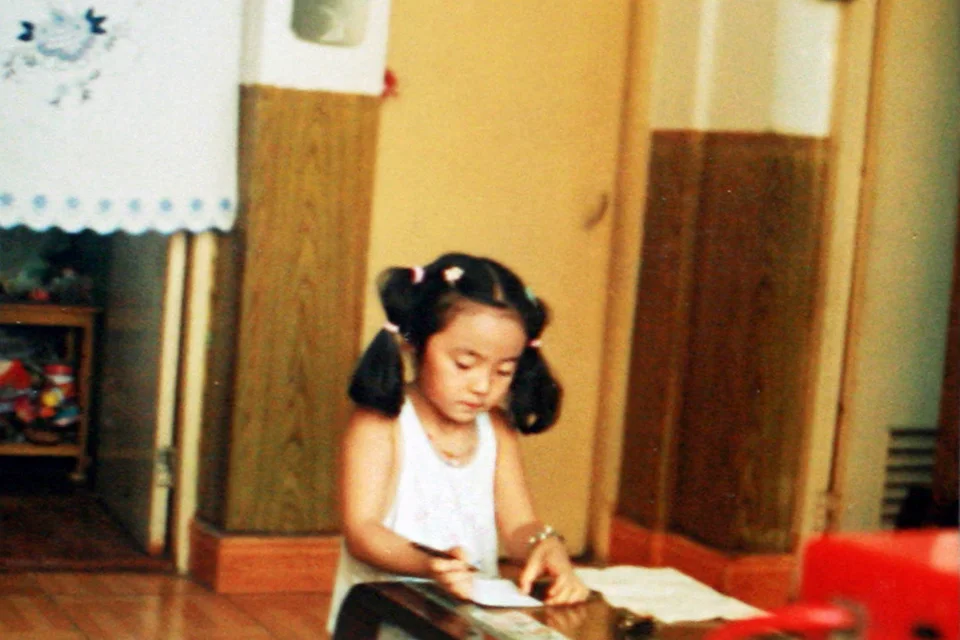
Reflecting on my own upbringing before we bring up the next generation.